Showing posts with label Intrinsic Value. Show all posts

Tuesday, November 6, 2012

Letter to shareholders of Icapital.biz Bhd. from Laxey Partners Ltd, the largest single shareholder in the company

Dear fellow shareholder of Icapital.biz Bhd.

As of 2nd November 2012, funds managed by Laxey Partners Ltd ("Laxey") owned 9,645,191 shares in Icapital.biz Bhd ("ICAP"), being 6.89% of the shares in issue. Laxey have been a Shareholder since 2010 in ICAP.

The purpose of this letter is to provide Shareholders with information relating to the Resolutions to be tabled at the forthcoming AGM. We would urge you to:

Vote Against Resolution 3: To re‐elect Datuk Ng Peng Hong @ Ng Peng Hay

Vote Against Resolution 4: To re‐elect Dato’ Dr. Norraesah Binti Mohamad

Vote Against Resolution 6: To re‐appoint Tunku Tan Sri Dato Seri Ahmad

Vote Against Resolution 7: To re‐appoint Tunku Abdul Aziz bin Tunku Ibrahim

Vote FOR Resolution 10: To elect Mr. Andrew Pegge as Director

Vote FOR Resolution 11: To elect Mr. Lo Kok Kee as Director

Vote FOR Resolution 12: To elect Mr. Low Nyap Heng as Director

Vote Against Resolution 13: To elect to elect Dato’ Tan Ang Meng as Director

Vote Against Resolution 14: To elect Dr. Yin Thing Phee @ Yin Thing Phi as Director


The Rationale:


Massive Persistent Discount:


While the manager has done a good job by delivering a NAV growth which has outperformed the FTSE Bursa Malaysia KLCI Index since inception, we are concerned about the substantial discount to Net Asset Value (“NAV”) that the fund has traded at and indeed continues to trade at. For the record we attach two charts from the Company 2012 Annual Report:


In page 4 of the Annual Report, a gain of 3% in NAV for the financial year, vs. a 1% gain for the FBMKLCI has been reported. However, the Index is not adjusted for dividend yield, which is in excess of 4% p.a., so the actual total return of the Index was in excess of 5.6%. Because the discount on which the Ordinary shares trade widened from 19.5% to 25.5%, the comparative total return to Shareholders was negative 4.5% – a total return underperformance of the index of 10.1%. So whilst the Fund Manager received a 13% increase in management fee, the “share owners” to use a term in the annual report, actually lost 4.5%.
 
This is where the Fund Manager’s and Shareholders’ interests diverge. The Fund Manager’s key performance measurement is the NAV, upon which its management fee is based, whereas for Shareholders, it is the share price ‐ which has suffered a widening discount.
 
Shareholders rely on the Board of their Company to address the issues facing them, which in the case of ICAP are, in our view, predominantly corporate governance related. Laxey has spoken to the Company to take action on the discount to no apparent effect. Laxey has earlier proposed a Resolution to be tabled at this AGM requesting the Board to address the persistent discount problem, but this was rejected by them.
 
In our view, one of the main reasons for the discount in ICAP to exist at such an unreasonable level is the lack of a defined policy to deal with the persistent and widening discount. The global closed end fund industry has over the last decade realised that a substantial discount is not in the interest of its owners – the shareholders. Incumbent boards globally have addressed the issue by instigating a series of measures which have collectively reduced both the absolute discount and discount volatility.
 
Share buybacks are one of the methods employed globally. In buying back shares cheaply, the Company can enhance its NAV per share for the benefit of all Shareholders. In addition, it should give investors confidence in the NAV, boost the demand for the shares of the Company and ultimately help to close the discount. The Company has cash backing of 99 sen/share as at 31st August 2012. Assuming this is unchanged, on 31st October 2012, with a market price of RM2.3/share and a NAV of RM2.96/share, the net NAV of the non‐cash portfolio is RM1.97/share against a market valuation net of cash of RM1.31/share, a discount of 33.5%. As a value investor like ICAP, what could be a better investment than buying your own portfolio at such a deep discount? We believe the Board should use an already available method to make a start on tackling the persistent and large discount. Even Warren Buffett, the value investor role model quoted by the Fund Manager, advocates buying back Berkshire Hathaway’s own shares if they are cheap enough. To quote from Warren Buffett 2011 Shareholder letter “At our limit price of 110% of book value, repurchases clearly increase Berkshire’s per‐share intrinsic value. And the more and the cheaper we buy, the greater the gain for continuing shareholders…” Are we not cheap enough yet?

Independence of the Board & Corporate Governance Issues:

The Chairman, Tunku Tan Sri Dato Sri Ahmad bin Tunku Yahya, is non‐independent because of his indirect shareholding in Capital Dynamics Asset Management S/B, the Fund Manager of the Company. From 1982 to 1993, he was Group CEO of the Sime Darby Bhd Group and until 2007, was its Deputy Chairman. An Independent Director, Mr. David Loo Kean Beng, started his career with Sime Darby Berhad in 1987 and left in 1997 as Senior Legal Adviser. Another INED, Tunku Abdul Aziz bin Tunku Ibrahim, was at one time, group director of Sime Darby Ltd, the exact period for which has not been specified.

The present composition of Directors would meet the requirements of the Bursa listing rules, but in terms of corporate governance, is it ideal? Should our Board be filled by a group of Directors with past ties to each other?

On 1st November, the Company announced the 5 additional nominees for election as Directors of the
Company at the forthcoming AGM.
Dr. Yin Thing Phee works at Sime Darby Medical Centre Subang Jaya.
Dato’ Tan Ang Meng is the ex‐CEO of the Fraser and Neave Holdings Berhad (F&N). As of 12th September 2012, ICAP holds RM41m worth of F&N, making it the 4th largest position in its portfolio.
Low Nyap Heng is 100% independent of the Company and the Sime Darby network.
Lo Kok Kee is 100% independent of the Company and the Sime Darby network.
Mr. Pegge is 100% independent of the Company and the Sime Darby network. He is the co‐
founder and a Director of Laxey.
Their profiles are at the end of the letter.

Moving Forward:

We believe that a Board of Directors should bring forward proposals to eliminate or substantially narrow the discount that the shares of the Company trade at relative to their NAV. This is a growing problem for our Company.

The Company could, as a minimum, consider implementing a share buy‐back scheme in accordance with the provisions of Section 67A of the Companies Act, 1965 of Malaysia, in order to give investors confidence and to boost the demand for the shares of the Company. We believe that the Board should concurrently engage advisors to research other methods to permanently remove the substantial discount at which the shares trade.

We have lost our confidence in the ability and commitment of the Board to address such an important issue.
 
What Shareholders didn’t get a chance to approve was a scheme that could address the discount issue. This could be your only chance to choose between the status quo and a continued discount or a change and the search for a solution to address the discount.

Conclusion:

We are long term investors seeking to restore shareholder value and have been investing in the local market since 2002.
We are a strong believer in the importance of high and proper standards of corporate governance.
We believe the changes in the Board would be in the best interests of all shareholders.
The discount that the shares of the Company trade at relative to their NAV simply reflects the weak investor sentiment in the Company.
Our Board should research the means to permanently remove the discount to NAV which our shares trade at, and bring forward proposals to enact those recommendation forthwith.
We believe that by introducing new Directors, the disparity between the current share price and NAV will be addressed to the benefit of all.

Profile of Andrew Pegge:

Andrew Pegge, a British citizen, is 100% independent of the ICAP.

Andrew Pegge started his investment career with Laurentian Fund Management in 1987. In 1990 he joined Buchanan Partners Limited where he was initially responsible for systems planning and integration, later developing a process of systematic analysis and management of investment situations in both mainstream and emerging equity markets. In 1995, Andrew, with Colin Kingsnorth, set up Kingpin, where as Chairman he had responsibility for managing the group's global emerging markets; Following the decision to relocate to the Isle of Man, Andrew spent six months with the Isle of Man Financial Supervision Commission as Supervisor of Collective Investment Schemes. After 8 months in this role he left, in late 1999 to found Laxey Partners Limited again with Mr Kingsnorth. He holds an Honours degree in Psychology and Cognitive Studies, an MBA and is a CFA charter holder.

Mr Pegge currently sit on the boards of a number of public listed companies as Independent Non‐ executive director, including ASA Limited – a Bermudan domiciled New York Stock Exchange listed fund that comes under the supervision of the United States SEC; Sefalana Holding Company a company both domiciled and listed in Botswana; and the Value Catalyst Fund Limited – a fund managed by Laxey Partners that recently delisted having offered shareholders the opportunity of electing for realisation shares at NAV. He contributes significantly in his roles as Member of various board committees.

Profile of Low Nyap Heng:

Mr. Low Nyap Heng is a Malaysian, aged 61 and a Fellow member of the Institute of Chartered Secretaries and Administrators, United Kingdom. He was the Chief Executive Officer of Ayer Hitam Tin Dredging (Malaysia) Berhad from 1991 to 1993. He had also served as Executive Director of Kampung Lanjut Tin Dredging Berhad and Director of Roxy Industries Malaysia Berhad and Projects for Asia Management Sdn Bhd. He was also the Executive Director of Jackin International Holdings Limited from 2003 to 2007, the shares of which are listed on the main board of The Stock Exchange of Hong Kong Limited. Currently he is the Vice President of Cen‐1 Partners, a corporate advisory and consultancy firm in Hong Kong.

Profile of Lo Kok Kee:

Mr. Lo was director and shareholder of Jupiter Securities Sdn Bhd, participating organization of Bursa Malaysia Securities Bhd. Prior to that, he was director and shareholder of OSK & Partners Sdn Bhd, the forerunner of the present OSK Investment Bank.

Mr. Lo has long been involved in shareholder activism, before it became fashionable. In 1990, he unsuccessfully proposed the open‐ending of Overseas Union Securities Ltd.(OUS), a closed‐end fund listed on the Singapore Stock Exchange, which was trading at persistent deep discount to net asset. OUS has since merged with United International Securities Ltd. while the other two closed‐end funds, Harimau Investments Ltd and General Securities Investment Ltd, had gone into members’ voluntary liquidation, after failing to narrow the persistent discount to NAV.

More recently, in 2009, he initiated and successfully moved the members’ voluntary liquidation of Amanah Harta Tanah PNB2 (AHP2), an underperforming real estate investment trust managed by PNB, the first such liquidation in the history of the Bursa. Members were able to realise a distribution of RM 1 compared to the prior market price of around 50 sen/unit.

Mr. Lo holds bachelor degrees in Agriculture and Economics from the University of Saskatchewan, Canada as a Colombo Plan scholar. He also holds an MBA, majoring in Finance and Accounting, from the Chicago Booth Business School, University of Chicago, where he studied under Nobel laureates Professors Merton Miller and Myron Scholes.

Thursday, October 21, 2010

About Gold

Is Gold a good investment?
It depends what's your definition of "good". When compared to cash, i think Gold is a better choice, since government have the legal license to keep printing money and thus diluting our cash while we're not compensated enough from interest earned from our cash. That is assuming you're not buying Gold at an overvalued price.

But i don't keep my surplus in "cash". I don't enjoy being "poor" slowly but surely.

To me, keeping Gold is like running on a treadmill. Yes, you're running, but you're going nowhere (after adjusted for inflation). On the other hand, keeping cash is even worse! That's like walking up slower than the escalator coming down, and thereby you're moving slower and slower down.

Question : Where do you think gold will be in five years and should that be a part of value investing?

Buffett : I have no views as to where it will be, but the one thing I can tell you is it won't do anything between now and then except look at you. Whereas, you know, Coca-Cola will be making money, and I think Wells Fargo will be making a lot of money and there will be a lot--and it's a lot--it's a lot better to have a goose that keeps laying eggs than a goose that just sits there and eats insurance and storage and a few things like that. The idea of digging something up out of the ground, you know, in South Africa or someplace and then transporting it to the United States and putting into the ground, you know, in the Federal Reserve of New York, does not strike me as a terrific asset.

Source: Ask Warren Buffett on CNBC's Squawk Box - Part 7 (9th March 2009)

Buffett also says "You could take all the gold that's ever been mined, and it would fill a cube 67 feet in each direction. For what that's worth at current gold prices, you could buy all -- not some -- all of the farmland in the United States. Plus, you could buy 10 Exxon Mobils, plus have $1 trillion of walking-around money. Or you could have a big cube of metal. Which would you take? Which is going to produce more value?"

Benjamin Graham in The Intelligent Investor also expresses his opposition to investing in gold.

Jeremy Siegel in Stocks for the Long Run writes how gold has barely beaten inflation over the past 200 years.

It is impossible to put an intrinsic value on gold. Companies or properties can be evaluated in numerous ways based on earnings, assets, growth etc. However, gold is just a metal which has no intrinsic value. Any time you are buying without establishing a margin of safety you are more likely speculating than you are investing.

If you buy gold at $1350 an ounce and it drops 50% there is no way to tell if it is trading above, at, or below its intrinsic value. That is why you will have no idea what do to if there is a sharp decline in gold prices. On the other hand, if you buy a property or stocks of a good company, you can check to see whether the earnings is affected as much as the drop in the price.

Take for instance, if you buy a property at RM 200,000 that gives you a Net annual rental of RM 20,000, giving you an annual rental return of 10%. If after 3 months and the property price drops to RM 100,000, we can check to see if the rental drops or not. If the rental did not drop, then we'll know that the property's intrinsic value did not drop. In fact, we can confidently buy more provided that the property price drop while rental remains. I don't know how we can say the same thing with Gold.

Owning a goose that lays eggs vs a goose that does nothing

From the green line of the graph above, it shows that Dow grows at a higher rate than Gold. Owning Equities represents ownership of companies and owning good companies is like owning a Goose that keeps on laying eggs.

Does Gold price keeps going up?

No! Infact, if you have bought at the "peak" in 1980, you have to wait 27 years to breakeven, and that's not including the depreciation of money over these 27 years. At this high price of gold currently, it's quite hard to justify recommending investing in gold.

Monday, August 16, 2010

Walter Schloss by Warren Buffett

This article was extracted from Warren Buffett's letters to Berkshire Hathaway's shareholders in 2006. It's available at : http://www.berkshirehathaway.com/letters/2006ltr.pdf
____________________________________________________________________

Let me end this section by telling you about one of the good guys of Wall Street, my long-time
friend Walter Schloss, who last year turned 90. From 1956 to 2002, Walter managed a remarkably
successful investment partnership, from which he took not a dime unless his investors made money. My admiration for Walter, it should be noted, is not based on hindsight. A full fifty years ago, Walter was my sole recommendation to a St. Louis family who wanted an honest and able investment manager.

Walter did not go to business school, or for that matter, college. His office contained one file
cabinet in 1956; the number mushroomed to four by 2002. Walter worked without a secretary, clerk or bookkeeper, his only associate being his son, Edwin, a graduate of the North Carolina School of the Arts. Walter and Edwin never came within a mile of inside information. Indeed, they used “outside” information only sparingly, generally selecting securities by certain simple statistical methods Walter learned while working for Ben Graham. When Walter and Edwin were asked in 1989 by Outstanding Investors Digest, “How would you summarize your approach?” Edwin replied, “We try to buy stocks cheap.” So much for Modern Portfolio Theory, technical analysis, macroeconomic thoughts and complex algorithms.

Following a strategy that involved no real risk – defined as permanent loss of capital – Walter
produced results over his 47 partnership years that dramatically surpassed those of the S&P 500. It’s particularly noteworthy that he built this record by investing in about 1,000 securities, mostly of a lackluster type. A few big winners did not account for his success. It’s safe to say that had millions of investment managers made trades by a) drawing stock names from a hat; b) purchasing these stocks in comparable amounts when Walter made a purchase; and then c) selling when Walter sold his pick, the luckiest of them would not have come close to equaling his record. There is simply no possibility that what Walter achieved over 47 years was due to chance.

I first publicly discussed Walter’s remarkable record in 1984. At that time “efficient market
theory” (EMT) was the centerpiece of investment instruction at most major business schools. This theory, as then most commonly taught, held that the price of any stock at any moment is not demonstrably mispriced, which means that no investor can be expected to overperform the stock market averages using only publicly-available information (though some will do so by luck). When I talked about Walter 23 years ago, his record forcefully contradicted this dogma.

And what did members of the academic community do when they were exposed to this new and
important evidence? Unfortunately, they reacted in all-too-human fashion: Rather than opening their minds, they closed their eyes. To my knowledge no business school teaching EMT made any attempt to study Walter’s performance and what it meant for the school’s cherished theory.

Instead, the faculties of the schools went merrily on their way presenting EMT as having the
certainty of scripture. Typically, a finance instructor who had the nerve to question EMT had about as much chance of major promotion as Galileo had of being named Pope.

Tens of thousands of students were therefore sent out into life believing that on every day the price
of every stock was “right” (or, more accurately, not demonstrably wrong) and that attempts to evaluate businesses – that is, stocks – were useless. Walter meanwhile went on overperforming, his job made easier by the misguided instructions that had been given to those young minds. After all, if you are in the shipping business, it’s helpful to have all of your potential competitors be taught that the earth is flat.

Maybe it was a good thing for his investors that Walter didn’t go to college.

____________________________________________________________________

His record: http://peterlim80.blogspot.com/2008/10/superinvestors-of-graham-and-doddsville_21.html

A good writeup on Walter J Schloss : http://www.gurufocus.com/news_print.php?id=21786

Monday, July 20, 2009

Obvious Mispricing / Inefficiency of 2 stocks in Bursa Malaysia


Imagine a supermarket selling 2 packages below:


Package 2 has all the same item as Package 1 (more in size, and also more items), but selling at an even lower price! Isn’t this insane? Given the 2 package below, you might wonder why there is anyone wants to buy Package 1. Any rational buyer would not pay that price for Package 1 when they can buy Package 2 at a lower price and owns more size of the same item, and include other items as well.

This is what happens with two of the stocks in Bursa Malaysia.

Kuala Lumpur Kepong Bhd (KLK) is 46.57% owned by Batu Kawan Berhad Bhd (BKAWAN) (See Appendix (a) for the source of the information). At market price of RM 12.00 per share (at 16th July 2009), the market value of KLK is RM 12.673 Billion , based on 1,064,965,692 shares outstanding (See Appendix (b) for the source of the information).

Since BKAWAN owns 46.57% of KLK, the fractional ownership in KLK is worth RM 5.951 Billion. On top of that, BKAWAN owns RM 386.4 Million of other Tangible Equity, out of which RM 135.4 Million is Net Cash (defined as Total Cash & Cash Equivalent minus Total Debts of the company) (See Appendix (c) for the source of the information).

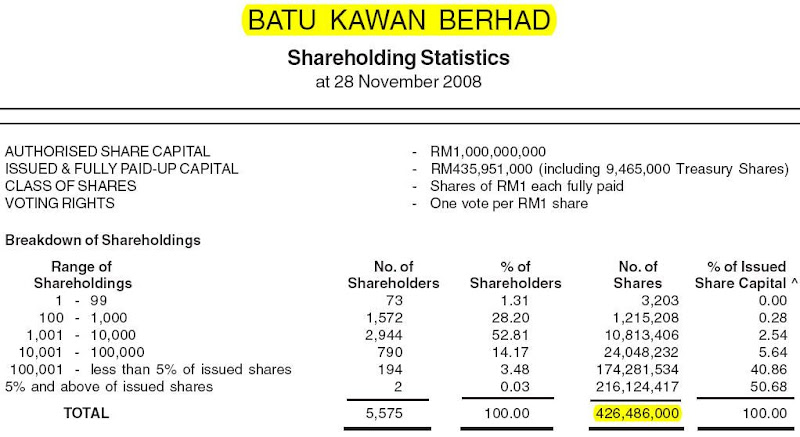
As at 31st March 2009, the number of shares outstanding in BKAWAN (after deducting treasury shares) is 426,487,000 (See Appendix (d) for the source of the information). Given the share price of RM 8.70 on 16th July 2009, the market value of BKAWAN is only RM 3.710 Billion !

Or putting in a table format for BKAWAN, you’ll get (based on 16th July 2009 closing price) (refer to Table 1):


Table 1 : Price vs Value of the entire company of Batu Kawan (BKAWAN)

If you see Table 1, you’ll notice that BKAWAN owns 495.902 Million shares of KLK. Since the entire company of BKAWAN is “sliced” into 426.487 Million pieces called shares, each share of BKAWAN owns 1.1628 shares of KLK indirectly!.

Stating this, each share of BKAWAN is definitely worth more than KLK share (after all, each BKAWAN shareholders owns 1.1628 shares of KLK + others assets too).

But the market priced KLK share higher than BKAWAN. Infact, BKAWAN is only priced at RM 8.70 while KLK is priced at RM 12.00!.

If you see this as madness, then look at per share basis for BKAWAN (refer to Table 2):


Table 2 : Price vs Value for 1 share of Batu Kawan (BKAWAN)


And if you compare KLK share with BKAWAN share side by side, you’ll get Table 3:


Table 3 : 1 share of KLK vs 1 share of BKAWAN

In an equation format, it’s as below:
1 BKAWAN share = 1.1628 KLK share + “Others Assets” worth roughly RM 0.90

The more obvious BKAWAN is a better value compared to KLK, the less obvious why “investors” would want to own KLK at higher price and not BKAWAN, which is selling at a lower price than KLK!. If you wonder why people would buy or own shares of KLK at RM 12.00 and not BKAWAN at RM 8.70, I can only share a line from a song by Michael Jackson, “You are not Alone – I am here with you”.

Some “investors” might say KLK have higher volume, which makes it easier for them to trade. On this, it reminds me of a quote by Warren Buffett, “Ease of divorce should not be the reason for marriage”. Infact, he also says, “If you don't feel comfortable owning something for 10 years, then don't own it for 10 minutes.”

Finally, I end with a quote by Warren Buffett on Fortune Magazine (April 3, 1995). He says, “I’d be a bum on the street with a tin cup if the markets were always efficient.” There are mispricing in stocks / securities, if we’re hard working in finding them.


Disclaimer: This article does not constitute a recommendation for buy or sell any stocks or securities. It is purely meant for educational purpose, and the author is not responsible for any loss arising from trade as a result from this article.

Appendix
a) Ownership of BKAWAN on KLK can be found in the 2008’s annual report (http://announcements.bursamalaysia.com/EDMS/subweb.nsf/7f04516f8098680348256c6f0017a6bf/bd4d7b1afc5330534825752f0018ed3f/$FILE/KLK-AnnualReport2008%20(2.8MB).pdf ) page 132 of 141 from the pdf file (or page 130 from the page number in the report).


b) Shares outstanding for KLK can be found in the 2008’s annual report (http://announcements.bursamalaysia.com/EDMS/subweb.nsf/7f04516f8098680348256c6f0017a6bf/bd4d7b1afc5330534825752f0018ed3f/$FILE/KLK-AnnualReport2008%20(2.8MB).pdf ) page 131 of 141 from the pdf file (or page 129 from the page number in the report).


c) BKAWAN’s tangible assets can be calculated by using the company’s “Equity attributable to equity holders of the company” minus “Goodwill on consolidation” from the 31st March 2009 Consolidated Balance Sheet of BKAWAN’s quarterly report. (http://announcements.bursamalaysia.com/EDMS/AnnWeb.nsf/all/482568AD00295D07482575C3003216F8/$File/BKB%20Q2%202009.pdf ) page 2 of 11 from the pdf file or from the page number in the report.

  • “Equity attributable to equity holders of the company” = RM 2,707.3 Million
  • “Goodwill on consolidation” = RM 18.4 Million
  • “Tangible Equity” = RM 2,707.3 Million - RM 18.4 Million = RM 2,688.9 Million

Since KLK is stated as RM 2,302.5 in the book, the balance (called “Other Tangible Equity”) is RM 386.4 Million.

BKAWAN’s Net Cash can be calculated by using the company’s “Cash and Short Term Investments” minus “Total Debt” from the 31st March 2009 Consolidated Balance Sheet of BKAWAN’s quarterly report. (http://announcements.bursamalaysia.com/EDMS/AnnWeb.nsf/all/482568AD00295D07482575C3003216F8/$File/BKB%20Q2%202009.pdf ) page 2 of 11 from the pdf file or from the page number in the report.

  • “Cash and Short Term Investments” = “Short Term Funds” + “Term Deposits” + “Cash and bank balances” = RM 98.4 Million + RM 70.7 Million + RM 1.9 Million = RM 171 Million
  • “Total Debt” = “Term Loans” = RM 35.6 Million
  • Net Cash = RM 171 Million – RM 35.6 Million = RM 135.4 Million


d) Shares outstanding for BKAWAN can be found in the 2008’s annual report (http://announcements.bursamalaysia.com/EDMS/subweb.nsf/7f04516f8098680348256c6f0017a6bf/d34a06927b8249ef482575280014e45d/$FILE/BKAWAN-AnnualReport2008%20(300KB).pdf ) page 84 of 89 from the pdf file (or page 82 from the page number in the report).


Since there are no share buybacks (from 28th November 2008 to 31st March 2009), the shares outstanding for BKAWAN remains the same.

Sunday, June 21, 2009

Very good article , "Buffett advice: Buy smart...and low"

I came across this article about Buffett in CNN, written by Jason Zweig. Here's some extracts of the article:
____________________________________________________________________

In response to a question from Barbara Kiviat of Time on how he and Munger control their emotions, Buffett replied: "[It] comes about from having an investment philosophy grounded in the idea that a stock is a piece of a business. If you look at it that way, there's no reason to get excited whether some analyst is recommending it or the company is splitting the shares two-for-one, or whatever. The only way to drive the extraneous thoughts out of your mind is to have a philosophy. And for us that philosophy comes from Benjamin Graham and The Intelligent Investor, especially chapters 8 and 20. It's not very complicated stuff."

You need a philosophy and the ability to think independently...It doesn't make any difference what other people think of a stock. What matters is whether you know enough to evaluate the business.

You should be able to write down on a yellow sheet of paper, 'I'm buying General Motors at $22, and GM has [566] million shares for a total market value of $13 billion, and GM is worth a lot more than $13 billion because _______________." And if you can't finish that sentence, then you don't buy the stock.

The key is not to be seduced by crazy ideas, but instead just stick to the fundamentals year after year. Academia doesn't get too interested in us -- we're too simple. What would the professors do? A great many of the formulas [they use to analyze securities and markets] are dead wrong. They exist purely to give the intellectual class something to do. We don't do anything just exercise our intellectual proclivity for mathematical formulas.

There's no reason we should become fearful if a stock goes down. If a stock goes down 50%, I'd look forward to it. In fact, I would offer you a significant sum of money if you could give me the opportunity for all of my stocks to go down 50% over the next month.

In that single sentence Buffett captured the difference between investing and speculating: An investor, like Buffett, wants the price of a stock to fall below the value of its underlying business so he can buy even more and hold for as long as possible. A speculator (like Jim Cramer) only wants the price of a stock to go up, with no regard for the value of the underlying business at all, so he can sell as fast as possible. To the investor, the market's opinions do not matter. To the speculator, they are the only thing that matters.

A Chinese reporter asked whether Berkshire will be buying more stocks in China now that its market has fallen by almost half, and what the next year will hold for Chinese investors. Buffett's answer held a lesson for investors based anywhere. "We're not in the business of forecasting what the market will do in the next year," said Buffett. "But if a market goes down, we like that. There's no way Charlie and I get upset when stocks go down. We like it, because falling prices give us the opportunity to buy more good businesses at better prices."

____________________________________________________________________

Read the full article here : http://money.cnn.com/2008/05/05/news/companies/buffet.pm.wrap/

Monday, December 29, 2008

Introduction to Value Investing by Whitney Tilson

Whitney Tilson gave a good speech about Value Investing in 2008's Value Investing Conference. Although most of his ideas came from Warren Buffett, nevertheless, it's a good introduction to those who reads little of Warren Buffett's article.


His slides can be downloaded here:

Introduction
Mental Mistakes
Slides for Wednesday's Workshop
T2 Partners Presentation
Valuing Companies

The entire Video recordings of Value Investing Congress 2008

The entire conference presentation of Value Investing Congress 2008

Saturday, December 20, 2008

Distinction between Investment and Speculation

Benjamin Graham, a famous investor in his own right and also notable because he is the man that taught Warren Buffett to invest, defined the difference between speculation and investment in this famous passage from his book The Intelligent Investor.

“An investment operation is one which, upon thorough analysis promises safety of principal and an adequate return. Operations not meeting these requirements are speculative.”

Note that investing, according to Graham, consists equally of three elements:

  1. Thorough analysis - which means the study of the facts in the light of established standards of safety and value;
  2. Safety Of Principal - which means protection against loss under all normal or reasonably likely conditions orvariations;
  3. Adequate return - which means any rate or amount of return, however low, which the investor is willing to accept, provided he acts with reasonable intelligence;
    (Source: Security Analysis, 1934 Edition, by Benjamin Graham)

Like casino gambling or betting on the horses, speculating in the market can be exciting or even rewarding (if you happen to get lucky). But it’s the worst imaginable way to build your wealth. That’s because Wall Street, like Las Vegas or the racetrack, has calibrated the odds so that the house always prevails, in the end, against everyone who tries to beat the house at its own speculative game.

On the other hand, investing is a unique kind of casino—one where you cannot lose in the end, so long as you play only by the rules that put the odds squarely in your favor. People who invest make money for themselves; people who speculate make money for their brokers.

The most realistic distinction between the investor and the speculator is found in their attitude toward stock-market movements. The speculator's primary interest lies in anticipating and profiting from market fluctuations. The investor's primary interest lies in acquiring and holding suitable securities at suitable prices. Market movements are important to him in a practical sense, because they alternately create low price levels at which he would be wise to buy and high price levels at which he certainly should refrain from buying and probably would be wise to sell."

Benjamin Graham also say that to have a true investment there must be present a true margin of safety. And a true margin of safety is one that can be demonstrated by figures, by persuasive reasoning, and by reference to a body of actual experience.

Thursday, December 11, 2008

Definition of Intrinsic Value

This article was extracted from Berkshire Hathaway's Owner's Manual written by Warren Buffett. It's available at : http://www.berkshirehathaway.com/ownman.pdf

____________________________________________________________________

Intrinsic value is an all-important concept that offers the only logical approach to evaluating the relative attractiveness of investments and businesses. Intrinsic value can be defined simply: It is the discounted value of the cash that can be taken out of a business during its remaining life.

The calculation of intrinsic value, though, is not so simple. As our definition suggests, intrinsic value is an estimate rather than a precise figure, and it is additionally an estimate that must be changed if interest rates move or forecasts of future cash flows are revised. Two people looking at the same set of facts, moreover — and this would apply even to Charlie and me — will almost inevitably come up with at least slightly different intrinsic value figures. That is one reason we never give you our estimates of intrinsic value. What our annual reports do supply, though, are the facts that we ourselves use to calculate this value.

Meanwhile, we regularly report our per-share book value, an easily calculable number, though one of limited use. The limitations do not arise from our holdings of marketable securities, which are carried on our books at their current prices. Rather the inadequacies of book value have to do with the companies we control, whose values as stated on our books may be far different from their intrinsic values.

The disparity can go in either direction. For example, in 1964 we could state with certitude that Berkshire’s per-share book value was $19.46. However, that figure considerably overstated the company’s intrinsic value, since all of the company’s resources were tied up in a sub-profitable textile business. Our textile assets had neither going-concern nor liquidation values equal to their carrying values. Today, however, Berkshire’s situation is reversed: Now, our book value far understates Berkshire’s intrinsic value, a point true because many of the businesses we control are worth much more than their carrying value.

Inadequate though they are in telling the story, we give you Berkshire’s book-value figures because they today serve as a rough, albeit significantly understated, tracking measure for Berkshire’s intrinsic value. In other words, the percentage change in book value in any given year is likely to be reasonably close to that year’s change in intrinsic value.

You can gain some insight into the differences between book value and intrinsic value by looking at one form of investment, a college education. Think of the education’s cost as its "book value." If this cost is to be accurate, it should include the earnings that were foregone by the student because he chose college rather than a job.

For this exercise, we will ignore the important non-economic benefits of an education and focus strictly on its economic value. First, we must estimate the earnings that the graduate will receive over his lifetime and subtract from that figure an estimate of what he would have earned had he lacked his education. That gives us an excess earnings figure, which must then be discounted, at an appropriate interest rate, back to graduation day. The dollar result equals the intrinsic economic value of the education.

Some graduates will find that the book value of their education exceeds its intrinsic value, which means that whoever paid for the education didn’t get his money’s worth. In other cases, the intrinsic value of an education will far exceed its book value, a result that proves capital was wisely deployed. In all cases, what is clear is that book value is meaningless as an indicator of intrinsic value.

Source : Berkshire Hathaway's Owner's Manual http://www.berkshirehathaway.com/ownman.pdf

____________________________________________________________________
This paragraph was extracted from Warren Buffett's letters to Berkshire Hathaway's shareholders in 1992. It's available at : http://www.berkshirehathaway.com/letters/1992.html

In The Theory of Investment Value, written over 50 years ago, John Burr Williams set forth the equation for value, which we condense here: The value of any stock, bond or business today is determined by the cash inflows and outflows - discounted at an appropriate interest rate - that can be expected to occur during the remaining life of the asset. Note that the formula is the same for stocks as for bonds.

Get from Amazon from the links below.


___________________________________________________________________


A good write-up about Intrinsic Value by Sham Grad in Fool.com : http://www.fool.com/investing/value/2007/08/01/security-analysis-201-intrinsic-value.aspx