Confucious says, "A man should practice what he preaches, but a man should also preach what he practices.". After reading this, i believe i should preach more what i practices for the society to see things the way i see it (and condemn on my mistakes too!).
He also says, "If you think in terms of a year, plant a seed; if in terms of ten years, plant trees; if in terms of 100 years, teach the people. "
More quotes from Confucious: http://www.1000ventures.com/business_guide/crosscuttings/cultures_confucius.html
Thursday, April 1, 2010


Saturday, March 6, 2010
Some Questions (Q) and Answers (A) about investing
Q: Calculation of Intrinsic value depends on how accurate is business evaluation on projected income growth
A: I don't use that, because i don't forecast/ project. I don't see any difference in forecast vs speculate, which to me, both are gambling. Ask any person who does business/ in the sales line, and ask them to project their income growth "accurately" (some so-called analyst even project to 2 decimal point), which i find it amusing.
Q: What is the Risk free Rate for Malaysian stocks
A: There is no such thing as "risk-free rate for stocks". All stocks have Risk (and depending your definition of "risk", all financial instruments have risk, including FD which have one of the highest risk of inflation "depreciating" your money).
Academicians and Statisticians defines risk as "volatility (or fluctuation) of its price around their return". Based on such definition, Risk Free Rate in Malaysia (if you're asking that) is the FD rate. Depending on your definition again, it could be 1 month FD, 1 year FD, or even the FD rate that you're getting.
Q: Identify good companies
A: A good company is one which consistently generates high Return on Equity on its normalised earnings. A good company might not mean a good investment (if you're paying a high price for it), though it's a good place to start.
A: I don't use that, because i don't forecast/ project. I don't see any difference in forecast vs speculate, which to me, both are gambling. Ask any person who does business/ in the sales line, and ask them to project their income growth "accurately" (some so-called analyst even project to 2 decimal point), which i find it amusing.
Q: What is the Risk free Rate for Malaysian stocks
A: There is no such thing as "risk-free rate for stocks". All stocks have Risk (and depending your definition of "risk", all financial instruments have risk, including FD which have one of the highest risk of inflation "depreciating" your money).
Academicians and Statisticians defines risk as "volatility (or fluctuation) of its price around their return". Based on such definition, Risk Free Rate in Malaysia (if you're asking that) is the FD rate. Depending on your definition again, it could be 1 month FD, 1 year FD, or even the FD rate that you're getting.
Q: Identify good companies
A: A good company is one which consistently generates high Return on Equity on its normalised earnings. A good company might not mean a good investment (if you're paying a high price for it), though it's a good place to start.
Wednesday, January 27, 2010
Integrity & Investment Performance
“Index funds are imperfect, but they provide the best outcome for most know-nothings, in order to avoid being misled by fools and liars.”
Quote by Charlie Munger
From the article of Stableboy Selections, i borrow his definition of Investing. "Investing is the process of putting money away now to be sure of getting more money back in the future."
If you agree with this definition, then you'll realize most people Speculate rather than Invest. No wonder they have poor long term results. (Do you know any gamblers who have good long term results? However, I know a lot of Casinos that earned a good long term results)
Read his article here: http://stableboyselections.com/2008/05/11/integrity-investment-performance/
Quote by Charlie Munger
From the article of Stableboy Selections, i borrow his definition of Investing. "Investing is the process of putting money away now to be sure of getting more money back in the future."
If you agree with this definition, then you'll realize most people Speculate rather than Invest. No wonder they have poor long term results. (Do you know any gamblers who have good long term results? However, I know a lot of Casinos that earned a good long term results)
Read his article here: http://stableboyselections.com/2008/05/11/integrity-investment-performance/
Tuesday, January 26, 2010
Warren Buffett on long term value investing
I came across a very interesting article about Warren Buffett's method of investing, and thought of sharing the link here:
http://www.tomspencer.com.au/2008/04/06/warren-buffett-on-long-term-value-investing/
A must read for Buffett wannabe!
http://www.tomspencer.com.au/2008/04/06/warren-buffett-on-long-term-value-investing/
A must read for Buffett wannabe!
Thursday, October 15, 2009
Is a low price fund means higher potential gains?
To answer this question, we need to understand how a unit trust fund’s price is derived daily. For example, why a particular fund’s unit price is is RM 0.2858 in a particular day, and not RM 0.2832 or even RM 0.2953. Who determines this price, and how is this price derived?
A fund’s price is determined by the underlying asset’s closing market price divide by total number of units of that fund on that particular day. This is the equation:
Fund’s Unit Price = Underlying Asset’s Closing Market Price / Total Units in the fund.
From the above equation, the fluctuation in a Fund’s Unit Price depends on the Underlying Assets, and it doesn’t depend on the fund’s Unit Price. After all, a fund’s unit price depends on “how many slices the fund is sliced”. The more units sliced, the fund’s unit price will be lower.
In fact, if both funds have the same Assets in the same proportion, both funds will fluctuate in the exact percentage, irrespective of the number of units in the fund. Putting it in a laymen way, if Fund A with unit price of RM 0.20 per unit increased by RM 0.10, then fund B with unit price of RM 1.00 per unit will increase by RM 0.50 (and NOT RM 0.10)!, if both funds have the same underlying assets at the same proportion. Both funds will increase by the same percentage, and not by the same amount!.
How about in reality (as oppose to the above “theory”)? Let’s take a look at 2 funds from one of the unit trust companies in Malaysia.
Fund A’s unit price is RM 0.4042 on 2nd Oct 2006, while Fund B’s unit price is only RM 0.2156. If a person wants an “aggressive” fund (fund which fluctuates in prices a lot), does it mean that Fund B is better? Or does it mean that fund B have more potential for higher return simply because the fund price is lower? Let’s take a look at their month by month’s prices from 2nd Oct 2006 until 1st Oct 2009 below:
Fund A (the fund that have a unit price almost double of Fund B) have (in terms of percentage):
a) Higher Return
b) Higher advancement from the lowest price to the highest.
c) Higher changes in a month
In conclusion, a fund’s unit price does not tell whether the fund is a volatile fund, better potential for higher returns or it’s an undervalued fund.
A much better way to measure a fund’s volatility (fluctuation in unit prices) is looking at:
A fund’s price is determined by the underlying asset’s closing market price divide by total number of units of that fund on that particular day. This is the equation:
Fund’s Unit Price = Underlying Asset’s Closing Market Price / Total Units in the fund.
From the above equation, the fluctuation in a Fund’s Unit Price depends on the Underlying Assets, and it doesn’t depend on the fund’s Unit Price. After all, a fund’s unit price depends on “how many slices the fund is sliced”. The more units sliced, the fund’s unit price will be lower.
In fact, if both funds have the same Assets in the same proportion, both funds will fluctuate in the exact percentage, irrespective of the number of units in the fund. Putting it in a laymen way, if Fund A with unit price of RM 0.20 per unit increased by RM 0.10, then fund B with unit price of RM 1.00 per unit will increase by RM 0.50 (and NOT RM 0.10)!, if both funds have the same underlying assets at the same proportion. Both funds will increase by the same percentage, and not by the same amount!.
How about in reality (as oppose to the above “theory”)? Let’s take a look at 2 funds from one of the unit trust companies in Malaysia.
Fund A’s unit price is RM 0.4042 on 2nd Oct 2006, while Fund B’s unit price is only RM 0.2156. If a person wants an “aggressive” fund (fund which fluctuates in prices a lot), does it mean that Fund B is better? Or does it mean that fund B have more potential for higher return simply because the fund price is lower? Let’s take a look at their month by month’s prices from 2nd Oct 2006 until 1st Oct 2009 below:
*NAV is adjusted for unit splits/ bonus issue or distributions.
Simple Analysis
Fund A (the fund that have a unit price almost double of Fund B) have (in terms of percentage):
a) Higher Return
b) Higher advancement from the lowest price to the highest.
c) Higher changes in a month
In conclusion, a fund’s unit price does not tell whether the fund is a volatile fund, better potential for higher returns or it’s an undervalued fund.
A much better way to measure a fund’s volatility (fluctuation in unit prices) is looking at:
- Fund’s Asset Allocation (percent in Equities, Bonds, and Money Market).
- Funds that invest mainly in Equities will fluctuate more than funds that invest mainly in Bonds.
- Funds that invest mainly in Bonds will fluctuate more than funds that invest mainly in Money Market.
- In fact, more than 90% of the long term return can be attributed by Asset Allocation. - Fund’s objective/ restrictions or sub-category of the Assets Class.
- Funds that invest in overseas will fluctuate more than funds that invest locally (due to currency exchange fluctuation)
- Funds that invest in high dividend paying stocks will fluctuate less than funds that invest in low dividend paying stocks (like growth stocks).
- Funds that invest in a specific sector/ group will fluctuate more than funds that are well diversified (no particular concentration on any sector/ group).
- Though these factors do determine the fund’s fluctuation, but it doesn’t play a big role like (1) above.
Luckily for laymen, FMUTM did a good job to make it compulsory for all unit trust funds that have 3 years track record to publish their fund’s volatily. Read their full article here: http://fmutm.com.my/doc/BrochureinvestorMay09.pdf .
Anyone still thinks Berkshire Hathaway class A at USD 100,000 per share is “expensive” when compared to a “cheap” share of USD 1 per share?
More often than not, it’s the other way round!.
Monday, July 20, 2009
Obvious Mispricing / Inefficiency of 2 stocks in Bursa Malaysia
Imagine a supermarket selling 2 packages below:
Package 2 has all the same item as Package 1 (more in size, and also more items), but selling at an even lower price! Isn’t this insane? Given the 2 package below, you might wonder why there is anyone wants to buy Package 1. Any rational buyer would not pay that price for Package 1 when they can buy Package 2 at a lower price and owns more size of the same item, and include other items as well.
This is what happens with two of the stocks in Bursa Malaysia.
Kuala Lumpur Kepong Bhd (KLK) is 46.57% owned by Batu Kawan Berhad Bhd (BKAWAN) (See Appendix (a) for the source of the information). At market price of RM 12.00 per share (at 16th July 2009), the market value of KLK is RM 12.673 Billion , based on 1,064,965,692 shares outstanding (See Appendix (b) for the source of the information).
Since BKAWAN owns 46.57% of KLK, the fractional ownership in KLK is worth RM 5.951 Billion. On top of that, BKAWAN owns RM 386.4 Million of other Tangible Equity, out of which RM 135.4 Million is Net Cash (defined as Total Cash & Cash Equivalent minus Total Debts of the company) (See Appendix (c) for the source of the information).
As at 31st March 2009, the number of shares outstanding in BKAWAN (after deducting treasury shares) is 426,487,000 (See Appendix (d) for the source of the information). Given the share price of RM 8.70 on 16th July 2009, the market value of BKAWAN is only RM 3.710 Billion !
Or putting in a table format for BKAWAN, you’ll get (based on 16th July 2009 closing price) (refer to Table 1):
This is what happens with two of the stocks in Bursa Malaysia.
Kuala Lumpur Kepong Bhd (KLK) is 46.57% owned by Batu Kawan Berhad Bhd (BKAWAN) (See Appendix (a) for the source of the information). At market price of RM 12.00 per share (at 16th July 2009), the market value of KLK is RM 12.673 Billion , based on 1,064,965,692 shares outstanding (See Appendix (b) for the source of the information).
Since BKAWAN owns 46.57% of KLK, the fractional ownership in KLK is worth RM 5.951 Billion. On top of that, BKAWAN owns RM 386.4 Million of other Tangible Equity, out of which RM 135.4 Million is Net Cash (defined as Total Cash & Cash Equivalent minus Total Debts of the company) (See Appendix (c) for the source of the information).
As at 31st March 2009, the number of shares outstanding in BKAWAN (after deducting treasury shares) is 426,487,000 (See Appendix (d) for the source of the information). Given the share price of RM 8.70 on 16th July 2009, the market value of BKAWAN is only RM 3.710 Billion !
Or putting in a table format for BKAWAN, you’ll get (based on 16th July 2009 closing price) (refer to Table 1):
Table 1 : Price vs Value of the entire company of Batu Kawan (BKAWAN)
If you see Table 1, you’ll notice that BKAWAN owns 495.902 Million shares of KLK. Since the entire company of BKAWAN is “sliced” into 426.487 Million pieces called shares, each share of BKAWAN owns 1.1628 shares of KLK indirectly!.
Stating this, each share of BKAWAN is definitely worth more than KLK share (after all, each BKAWAN shareholders owns 1.1628 shares of KLK + others assets too).
But the market priced KLK share higher than BKAWAN. Infact, BKAWAN is only priced at RM 8.70 while KLK is priced at RM 12.00!.
If you see this as madness, then look at per share basis for BKAWAN (refer to Table 2):
Stating this, each share of BKAWAN is definitely worth more than KLK share (after all, each BKAWAN shareholders owns 1.1628 shares of KLK + others assets too).
But the market priced KLK share higher than BKAWAN. Infact, BKAWAN is only priced at RM 8.70 while KLK is priced at RM 12.00!.
If you see this as madness, then look at per share basis for BKAWAN (refer to Table 2):
Table 2 : Price vs Value for 1 share of Batu Kawan (BKAWAN)
And if you compare KLK share with BKAWAN share side by side, you’ll get Table 3:
Table 3 : 1 share of KLK vs 1 share of BKAWAN
In an equation format, it’s as below:
1 BKAWAN share = 1.1628 KLK share + “Others Assets” worth roughly RM 0.90
The more obvious BKAWAN is a better value compared to KLK, the less obvious why “investors” would want to own KLK at higher price and not BKAWAN, which is selling at a lower price than KLK!. If you wonder why people would buy or own shares of KLK at RM 12.00 and not BKAWAN at RM 8.70, I can only share a line from a song by Michael Jackson, “You are not Alone – I am here with you”.
Some “investors” might say KLK have higher volume, which makes it easier for them to trade. On this, it reminds me of a quote by Warren Buffett, “Ease of divorce should not be the reason for marriage”. Infact, he also says, “If you don't feel comfortable owning something for 10 years, then don't own it for 10 minutes.”
Finally, I end with a quote by Warren Buffett on Fortune Magazine (April 3, 1995). He says, “I’d be a bum on the street with a tin cup if the markets were always efficient.” There are mispricing in stocks / securities, if we’re hard working in finding them.
Disclaimer: This article does not constitute a recommendation for buy or sell any stocks or securities. It is purely meant for educational purpose, and the author is not responsible for any loss arising from trade as a result from this article.
Appendix
a) Ownership of BKAWAN on KLK can be found in the 2008’s annual report (http://announcements.bursamalaysia.com/EDMS/subweb.nsf/7f04516f8098680348256c6f0017a6bf/bd4d7b1afc5330534825752f0018ed3f/$FILE/KLK-AnnualReport2008%20(2.8MB).pdf ) page 132 of 141 from the pdf file (or page 130 from the page number in the report).

b) Shares outstanding for KLK can be found in the 2008’s annual report (http://announcements.bursamalaysia.com/EDMS/subweb.nsf/7f04516f8098680348256c6f0017a6bf/bd4d7b1afc5330534825752f0018ed3f/$FILE/KLK-AnnualReport2008%20(2.8MB).pdf ) page 131 of 141 from the pdf file (or page 129 from the page number in the report).

c) BKAWAN’s tangible assets can be calculated by using the company’s “Equity attributable to equity holders of the company” minus “Goodwill on consolidation” from the 31st March 2009 Consolidated Balance Sheet of BKAWAN’s quarterly report. (http://announcements.bursamalaysia.com/EDMS/AnnWeb.nsf/all/482568AD00295D07482575C3003216F8/$File/BKB%20Q2%202009.pdf ) page 2 of 11 from the pdf file or from the page number in the report.
- “Equity attributable to equity holders of the company” = RM 2,707.3 Million
- “Goodwill on consolidation” = RM 18.4 Million
- “Tangible Equity” = RM 2,707.3 Million - RM 18.4 Million = RM 2,688.9 Million
Since KLK is stated as RM 2,302.5 in the book, the balance (called “Other Tangible Equity”) is RM 386.4 Million.
BKAWAN’s Net Cash can be calculated by using the company’s “Cash and Short Term Investments” minus “Total Debt” from the 31st March 2009 Consolidated Balance Sheet of BKAWAN’s quarterly report. (http://announcements.bursamalaysia.com/EDMS/AnnWeb.nsf/all/482568AD00295D07482575C3003216F8/$File/BKB%20Q2%202009.pdf ) page 2 of 11 from the pdf file or from the page number in the report.
- “Cash and Short Term Investments” = “Short Term Funds” + “Term Deposits” + “Cash and bank balances” = RM 98.4 Million + RM 70.7 Million + RM 1.9 Million = RM 171 Million
- “Total Debt” = “Term Loans” = RM 35.6 Million
- Net Cash = RM 171 Million – RM 35.6 Million = RM 135.4 Million


d) Shares outstanding for BKAWAN can be found in the 2008’s annual report (http://announcements.bursamalaysia.com/EDMS/subweb.nsf/7f04516f8098680348256c6f0017a6bf/d34a06927b8249ef482575280014e45d/$FILE/BKAWAN-AnnualReport2008%20(300KB).pdf ) page 84 of 89 from the pdf file (or page 82 from the page number in the report).
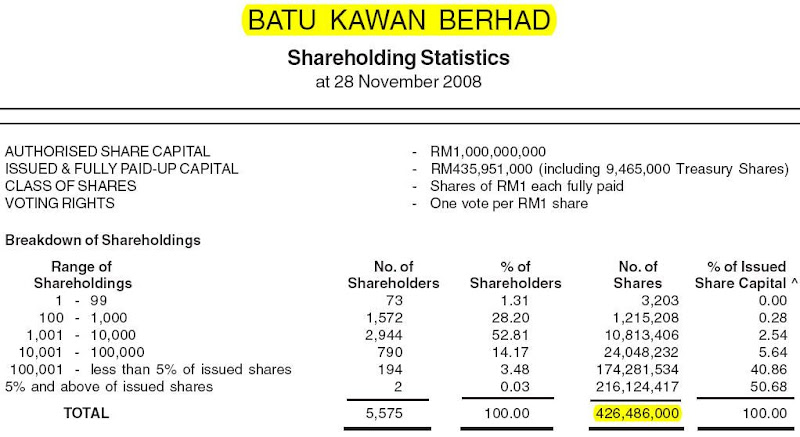
Since there are no share buybacks (from 28th November 2008 to 31st March 2009), the shares outstanding for BKAWAN remains the same.
Subscribe to:
Posts (Atom)


 Posts
Posts


