Monday, July 20, 2009

Obvious Mispricing / Inefficiency of 2 stocks in Bursa Malaysia


Imagine a supermarket selling 2 packages below:


Package 2 has all the same item as Package 1 (more in size, and also more items), but selling at an even lower price! Isn’t this insane? Given the 2 package below, you might wonder why there is anyone wants to buy Package 1. Any rational buyer would not pay that price for Package 1 when they can buy Package 2 at a lower price and owns more size of the same item, and include other items as well.

This is what happens with two of the stocks in Bursa Malaysia.

Kuala Lumpur Kepong Bhd (KLK) is 46.57% owned by Batu Kawan Berhad Bhd (BKAWAN) (See Appendix (a) for the source of the information). At market price of RM 12.00 per share (at 16th July 2009), the market value of KLK is RM 12.673 Billion , based on 1,064,965,692 shares outstanding (See Appendix (b) for the source of the information).

Since BKAWAN owns 46.57% of KLK, the fractional ownership in KLK is worth RM 5.951 Billion. On top of that, BKAWAN owns RM 386.4 Million of other Tangible Equity, out of which RM 135.4 Million is Net Cash (defined as Total Cash & Cash Equivalent minus Total Debts of the company) (See Appendix (c) for the source of the information).

As at 31st March 2009, the number of shares outstanding in BKAWAN (after deducting treasury shares) is 426,487,000 (See Appendix (d) for the source of the information). Given the share price of RM 8.70 on 16th July 2009, the market value of BKAWAN is only RM 3.710 Billion !

Or putting in a table format for BKAWAN, you’ll get (based on 16th July 2009 closing price) (refer to Table 1):


Table 1 : Price vs Value of the entire company of Batu Kawan (BKAWAN)

If you see Table 1, you’ll notice that BKAWAN owns 495.902 Million shares of KLK. Since the entire company of BKAWAN is “sliced” into 426.487 Million pieces called shares, each share of BKAWAN owns 1.1628 shares of KLK indirectly!.

Stating this, each share of BKAWAN is definitely worth more than KLK share (after all, each BKAWAN shareholders owns 1.1628 shares of KLK + others assets too).

But the market priced KLK share higher than BKAWAN. Infact, BKAWAN is only priced at RM 8.70 while KLK is priced at RM 12.00!.

If you see this as madness, then look at per share basis for BKAWAN (refer to Table 2):


Table 2 : Price vs Value for 1 share of Batu Kawan (BKAWAN)


And if you compare KLK share with BKAWAN share side by side, you’ll get Table 3:


Table 3 : 1 share of KLK vs 1 share of BKAWAN

In an equation format, it’s as below:
1 BKAWAN share = 1.1628 KLK share + “Others Assets” worth roughly RM 0.90

The more obvious BKAWAN is a better value compared to KLK, the less obvious why “investors” would want to own KLK at higher price and not BKAWAN, which is selling at a lower price than KLK!. If you wonder why people would buy or own shares of KLK at RM 12.00 and not BKAWAN at RM 8.70, I can only share a line from a song by Michael Jackson, “You are not Alone – I am here with you”.

Some “investors” might say KLK have higher volume, which makes it easier for them to trade. On this, it reminds me of a quote by Warren Buffett, “Ease of divorce should not be the reason for marriage”. Infact, he also says, “If you don't feel comfortable owning something for 10 years, then don't own it for 10 minutes.”

Finally, I end with a quote by Warren Buffett on Fortune Magazine (April 3, 1995). He says, “I’d be a bum on the street with a tin cup if the markets were always efficient.” There are mispricing in stocks / securities, if we’re hard working in finding them.


Disclaimer: This article does not constitute a recommendation for buy or sell any stocks or securities. It is purely meant for educational purpose, and the author is not responsible for any loss arising from trade as a result from this article.

Appendix
a) Ownership of BKAWAN on KLK can be found in the 2008’s annual report (http://announcements.bursamalaysia.com/EDMS/subweb.nsf/7f04516f8098680348256c6f0017a6bf/bd4d7b1afc5330534825752f0018ed3f/$FILE/KLK-AnnualReport2008%20(2.8MB).pdf ) page 132 of 141 from the pdf file (or page 130 from the page number in the report).


b) Shares outstanding for KLK can be found in the 2008’s annual report (http://announcements.bursamalaysia.com/EDMS/subweb.nsf/7f04516f8098680348256c6f0017a6bf/bd4d7b1afc5330534825752f0018ed3f/$FILE/KLK-AnnualReport2008%20(2.8MB).pdf ) page 131 of 141 from the pdf file (or page 129 from the page number in the report).


c) BKAWAN’s tangible assets can be calculated by using the company’s “Equity attributable to equity holders of the company” minus “Goodwill on consolidation” from the 31st March 2009 Consolidated Balance Sheet of BKAWAN’s quarterly report. (http://announcements.bursamalaysia.com/EDMS/AnnWeb.nsf/all/482568AD00295D07482575C3003216F8/$File/BKB%20Q2%202009.pdf ) page 2 of 11 from the pdf file or from the page number in the report.

  • “Equity attributable to equity holders of the company” = RM 2,707.3 Million
  • “Goodwill on consolidation” = RM 18.4 Million
  • “Tangible Equity” = RM 2,707.3 Million - RM 18.4 Million = RM 2,688.9 Million

Since KLK is stated as RM 2,302.5 in the book, the balance (called “Other Tangible Equity”) is RM 386.4 Million.

BKAWAN’s Net Cash can be calculated by using the company’s “Cash and Short Term Investments” minus “Total Debt” from the 31st March 2009 Consolidated Balance Sheet of BKAWAN’s quarterly report. (http://announcements.bursamalaysia.com/EDMS/AnnWeb.nsf/all/482568AD00295D07482575C3003216F8/$File/BKB%20Q2%202009.pdf ) page 2 of 11 from the pdf file or from the page number in the report.

  • “Cash and Short Term Investments” = “Short Term Funds” + “Term Deposits” + “Cash and bank balances” = RM 98.4 Million + RM 70.7 Million + RM 1.9 Million = RM 171 Million
  • “Total Debt” = “Term Loans” = RM 35.6 Million
  • Net Cash = RM 171 Million – RM 35.6 Million = RM 135.4 Million


d) Shares outstanding for BKAWAN can be found in the 2008’s annual report (http://announcements.bursamalaysia.com/EDMS/subweb.nsf/7f04516f8098680348256c6f0017a6bf/d34a06927b8249ef482575280014e45d/$FILE/BKAWAN-AnnualReport2008%20(300KB).pdf ) page 84 of 89 from the pdf file (or page 82 from the page number in the report).
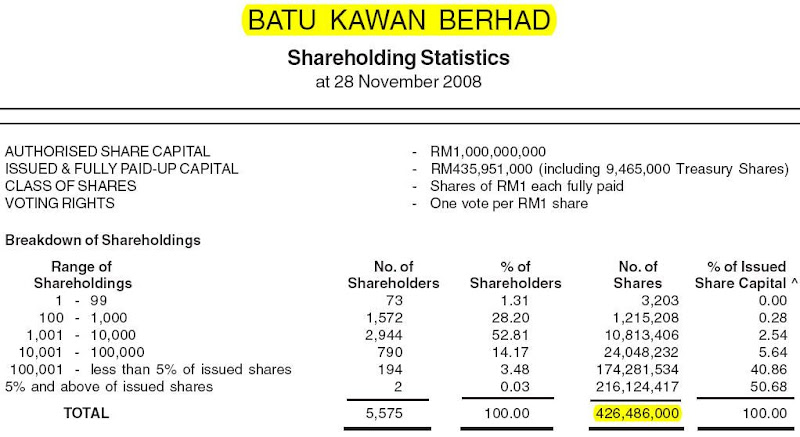


Since there are no share buybacks (from 28th November 2008 to 31st March 2009), the shares outstanding for BKAWAN remains the same.

Sunday, June 21, 2009

Very good article , "Buffett advice: Buy smart...and low"

I came across this article about Buffett in CNN, written by Jason Zweig. Here's some extracts of the article:
____________________________________________________________________

In response to a question from Barbara Kiviat of Time on how he and Munger control their emotions, Buffett replied: "[It] comes about from having an investment philosophy grounded in the idea that a stock is a piece of a business. If you look at it that way, there's no reason to get excited whether some analyst is recommending it or the company is splitting the shares two-for-one, or whatever. The only way to drive the extraneous thoughts out of your mind is to have a philosophy. And for us that philosophy comes from Benjamin Graham and The Intelligent Investor, especially chapters 8 and 20. It's not very complicated stuff."

You need a philosophy and the ability to think independently...It doesn't make any difference what other people think of a stock. What matters is whether you know enough to evaluate the business.

You should be able to write down on a yellow sheet of paper, 'I'm buying General Motors at $22, and GM has [566] million shares for a total market value of $13 billion, and GM is worth a lot more than $13 billion because _______________." And if you can't finish that sentence, then you don't buy the stock.

The key is not to be seduced by crazy ideas, but instead just stick to the fundamentals year after year. Academia doesn't get too interested in us -- we're too simple. What would the professors do? A great many of the formulas [they use to analyze securities and markets] are dead wrong. They exist purely to give the intellectual class something to do. We don't do anything just exercise our intellectual proclivity for mathematical formulas.

There's no reason we should become fearful if a stock goes down. If a stock goes down 50%, I'd look forward to it. In fact, I would offer you a significant sum of money if you could give me the opportunity for all of my stocks to go down 50% over the next month.

In that single sentence Buffett captured the difference between investing and speculating: An investor, like Buffett, wants the price of a stock to fall below the value of its underlying business so he can buy even more and hold for as long as possible. A speculator (like Jim Cramer) only wants the price of a stock to go up, with no regard for the value of the underlying business at all, so he can sell as fast as possible. To the investor, the market's opinions do not matter. To the speculator, they are the only thing that matters.

A Chinese reporter asked whether Berkshire will be buying more stocks in China now that its market has fallen by almost half, and what the next year will hold for Chinese investors. Buffett's answer held a lesson for investors based anywhere. "We're not in the business of forecasting what the market will do in the next year," said Buffett. "But if a market goes down, we like that. There's no way Charlie and I get upset when stocks go down. We like it, because falling prices give us the opportunity to buy more good businesses at better prices."

____________________________________________________________________

Read the full article here : http://money.cnn.com/2008/05/05/news/companies/buffet.pm.wrap/

Monday, April 13, 2009

National Savings Bond by the Malaysian Government

Referring to the newspaper article by TheStar on RM5bil National Savings Bond on sale from April 14 , i was asked whether this investment is good or not, and whether should they invest in it.

The main features of the National Savings Bond is as below:
  • Investment amount - ranges from RM 1,000 to maximum of RM 50,000, and in multiples of RM 100.
  • Tenure - 3 years
  • Frequency of interest payment - Quarterly
  • Interest - 5% Guaranteed by the Government. So, it's "safer" than keeping money in the Bank.

Details of the Bond is available in BMN's website:

So, back to the question, "Is it good?". The answer to this, depends on what you're comparing with.
"Is running fast?" That depends on whether you're comparing with walking, or driving.

Since Malaysian FD rates is going at 2.5% per year, then obviously this Bond is better.

However, is that the only choice we have for our money?

At 5% return, it'll take 14.4 years for our money to double (using the simple "Rule 72"). As our money earns interest (or returns), our money is also "eaten" up by inflation. Does it take 14.4 years for our expenses to doubled? I believe it'll take less than 14.4 years for goods to double in price due to inflation. I would estimate, between 8 to 12 years for goods to double in price.

Saying this, goods would double in price (due to inflation) BEFORE our money would double at the rate of 5% per year. I don't see anything safe about this. Infact, i don't see anything fun with getting poor slowly, but SURELY.

Most people would compare which product is better without understanding and knowing their needs. Truth is, which product, tools or medicine is better depends on your needs, and not on the product itself!

If you're having a headache, it doesn't matter whether Viagra is better, or Cialis is better. Both won't help much in your headache condition. What you need is a Panadol, and not choosing between Viagra or Cialis!

So, in what situation is this National Savings Bond good for you? I believe it's good if:
  1. You need the money within these 3 to 4 years, or
  2. You want to find a place to make your "Emergency Fund" earns higher return.
  3. You have No Dependant, have set aside emergency and medical funding, knowing that your personal inflation rate is lower than 5% yearly, and have a Net Worth that is more than your remaining lifespan multipled by your current yearly expenses.
  4. You know that you don't know how to invest, and don't trust anyone with your money. (Same analogy goes to driving a car: You know that you don't know how to drive, and don't trust any "driver" to drive you to Singapore, so.... you WALK from Penang to Singapore!")
  5. Can't think of any other reasons why this is good.

However, i don't and won't invest in it because:

  1. My needs within the next 3 to 5 years is in Bond Fund, which i will be using almost entirely within the next 3 months. So, the difference (if any), would be insignificant.
  2. I'm happy with my current emergency fund, putting it in Bond Fund. And since my income is "safe", i feel comfortable with 2 month's expenses being set aside for emergency fund.
  3. I don't have enough to retire on. I don't have RM 3.5 Million currently if my annual expenses is RM 50,000 and my remaining lifespan is 70 years.
  4. I believe i know what i'm doing with my investments, and i choose something something which fits my long term needs. Just as Michael Schumacher believes he knows how to drive fast and safe, it doesn't mean that driving fast is not safe!
  5. I trust Warren Buffett (thru Berkshire Hathaway) with more than 30% of my Net Worth, I trust Public Mutual with 90% of my Net Worth, and I also trust some of the CEO's of Public Listed Companies with my fractional ownership these companies.
  6. I don't enjoy getting poor slowly but surely. I enjoy getting rich slowly but surely!.

Most important of all, I won't choose between Walking or Running if i want to travel from Penang to Singapore. I would rather choose between Firefly, AirAsia, MAS or Singapore Airlines (though i believe it doesn't make much difference in the speed and safety between them).

I don't foresee a need for more than 90% of my assets for the next 5 years or longer, so i rather choose other financial "vehicles" to reach my financial "destination".

What financial "vehicles" is the best for a person who won't be needing the money for the next 5 years? Definitely in Ownership (of Business, or Real Estate) ! I'll write more about it next time. :-)

Wednesday, April 1, 2009

Introducing my Father-in-law & my Wife. They're "models" in Personal Money magazine October 2005 Issue

Yes, my father-in-law and my wife were in the front cover of Personal Money magazine. That time, she was my girl friend, and her father, well.... let's just say that I used to live in their house most of the time.


Isn't she pretty? She's getting prettier day by day. Take a look at her blog here.


Why are they in the front cover of Personal Money magazine holding money?. Well, they joined the Investment Game organised by the magazine (sponsored by Hwang DBS) together with me.

The contest lasted for 1 year, and the winner was decided based on the investor's return after deduction of all charges and transaction fees. My father-in-law was the Champion, and my wife was 4th. How about me? I got 6th position.


The top 25 is as below:

Special mention: The No. 14 winner, Tan Seok Luan is my good friend, and my 1st agent who joined me in Public Mutual. I informed her about the contest, and suggested her to join as soon as possible, and invest in a low cost Bond Fund with good past performance.
She took my advice, and she kept the winnings. :-)

A few things the 3 portfolios (my Father-in-law, my wife and mine) had in common:
1) We all lived in the same house at that time.
2) We used the same computer.
3) We ate dinner together most of the time... hehehe..
4) All the 3 portfolios were being "advised" by the same person. :-)

The position, total return, and the prize winnings of the 3 portfolios are as below:
1st - 15.26%, winning RM 80,000
4th - 10.40%, winning RM 20,000
6th - 9.23%, winning RM 3,000

Total Prize money won = RM 103,000.
Average return from the 3 portfolios : 11.63%


They interviewed the top 5 winners, and each has their own page story. I missed the Top 5 mark by 0.09%.


My Father-in-law's full page interview


My Wife's full page interview


The Winner's Circle. My name was mentioned, though i wasn't "promoted" as husband, yet.


What's interesting, is this small side article:

There were 2,326 unique participants, with 3,153 portfolios (some joined 2 or more entries). Since each person had an initial RM 100,000 virtual fund to start with, they as a group, managed RM 315 Million.

Average Losses for the 3,153 portfolio is -1.41% !!

Meaning, these 3,153 participants ended up with less than RM 315 Million after the contest ended. Mind you, that period, the KLCI went from 827.49 points on August 2nd 2004 (dropping to a low 804.89 points on August 24th 2004) to close at 937.39 on July 29th 2005, one of the highest KLCI points of the contest!

The results show:

  1. These contestants will better off just by putting their money in FD. At least they won't get a -ve return.
  2. In fact, they will be better off by not doing anything with the money (rather than simply buying unit trust funds). This way, the overall portfolio would be 0%, which is better than -1.41%!
  3. Or it could simply mean that they took this contest for "fun", and thought that they could not possibly be among the top 25 (6th position to 25th will get RM 3,000 worth of Unit Trust by Hwang-DBS).

I know i did not take this contest for fun as there is real money at stake! Infact, all my money (then, now, and future) are serious money. I think carefully before I put my money anywhere. I always compare what I pay with what I get.

Being frugal is totally a different meaning compared to being a miser.

In one my future entries, maybe I would explain more about the 4th position portfolio 'Dynamic Asset Allocation' which I believe is supposed to shine out among the 3 portfolios.

Tuesday, March 31, 2009

Discrepancy in IOI Corp and IOI Properties Stock price

Today, i noticed a discrepancy in prices between those 2 shares. Since i can't take advantage of it, might as well i share it here in the hope that you'll learn a lesson or two, and take advantage of it, if the condition fits you.

Let me share some background info:

1. On 4th February 2009, IOI Corp issues a Voluntary Take-Over Offer to take over IOI Properties at:
  • 0.6 shares of IOI Corp , and RM 0.33 CASH for every 1 share of IOI Properties.
    Full Details of the offer is here.

2. Then, on 30th March 2009, IOI Corp have already received (plus their own ownership in IOI Properties) in excess of 90% of the shares outstanding. Since they own more than 90%, the remaining shareholders of IOI Properties are "forced" to convert their shares to IOI Corp at above terms. Full Details of the 90% ownership of IOI Corp is here.

3. By 7th April 2009, IOI Properties would be delisted from Bursa Malaysia, and converted to IOI Corp shares at above terms.

So, the equation below must hold true.

1 IOI Properties share = 0.6 IOI Corp shares + RM 0.33 CASH

If the above equation differs by anything more than the brokerage fees involved (say, 1.5%), then arbitrage opportunity would arise.

As of this writing (4.30 pm on 31st March 2009), you can buy IOI Properties at RM 2.50 per share, and you can sell IOI Corp at RM 3.80 per share. Fitting it to the equation above:

Left Side : 1 IOI Properties share = RM 2.50

Right Side: 0.6 IOI Corp shares + RM 0.33 CASH = RM 2.61

That's a difference of 11 cents, or 4.4% !. Seeing this, I can buy 100,000 shares of IOI Properties at RM 2.50, and "sell" 60,000 shares of IOI Corp at the same time.

This way, i'm making a nearly risk free return of at least 3.4% in a week (that's the holding period for my IOI Properties shares to be converted to IOI Corp shares). After my IOI Properties shares is being converted to IOI Corp shares, i'll "return" the IOI Corp shares back to cover my short selling position.

Nice Arbitrage Opportunity? Too bad Short selling is not allowed in Malaysia since 1998. :-(.

However, if you own IOI Corp shares, you can sell those shares, and buy IOI Properties shares (with the above proportion). 1 week later, you'll have back the same number of IOI shares, and make at least 3.4% profit (assuming total brokerage fee is 1% both sides).

I know i would do that if i manage a portfolio of a few hundred Millions like a mutual fund. :-).

Would i just buy IOI Properties (without short selling IOI Corp at the same time), in the hope that i can sell IOI Corp shares at that above price 1 week later to make 3.4% profit?.
No, i won't. That involves risk, and possibly i might lose money. To me, this way is Speculation (and not Investing). Read the difference between Investing and Speculating here.

Friday, February 27, 2009

The Crisis of Credit Visualized

The best, simplest explaination of current Financial Crisis. Must Watch !


The Crisis of Credit Visualized from Jonathan Jarvis on Vimeo.